
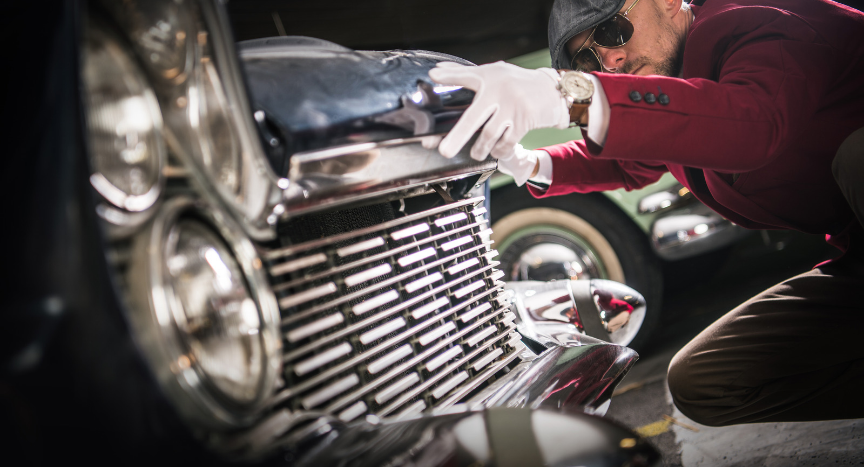
Some of the motorcoaches that once carried passengers across the country have been off regular routes for decades, but they have not all disappeared. Museums, preservation groups and private collectors have restored surviving examples, sometimes bringing vehicles that spent years in storage back to operating condition.
Preserving something this large is no small project. Parts can be difficult to find, storage is a challenge and restoring an original interior can require pieces that have not been manufactured in decades. The coaches that have survived offer something photographs cannot, providing a chance to see how motorcoach design, passenger space and equipment developed across different eras.
GM Silversides
The GM Silversides became one of the defining designs of American intercity travel around World War II. Its rounded body and fluted aluminum sides gave it an unmistakable appearance, but the coach also incorporated features that mattered to long-distance passengers, including underfloor baggage compartments and, on later models, air conditioning.
Postwar production included 2,000 diesel-powered Silversides built for Greyhound in 1947 and 1948, and at least one survivor remained in commercial service long enough to nearly begin a second career outside the United States.
That 1948 coach was originally delivered to Pacific Greyhound Lines and later scheduled to be sold to an operator in Peru. The shipment never happened, allowing the vehicle to remain in the United States and eventually become part of Greyhound’s historic fleet.
The Pacific Bus Museum acquired it in 2023. Restored and operable today, the 41-passenger coach still provides a working example of equipment that was once a familiar sight on American highways.
GM PD-4501 Scenicruiser
As the Silversides era gave way to the 1950s, General Motors took intercity coach design in a much different direction with the PD-4501 Scenicruiser.
Built from 1954 through 1956, the Scenicruiser used a split-level arrangement rather than a conventional single passenger floor. Ten passengers sat in the lower front portion while another 33 occupied the elevated rear section, creating the stepped roofline that made the coach instantly recognizable.
The original mechanical setup was just as unusual. Two diesel engines worked through a single transmission, but reliability problems eventually led to a major rebuilding program. Beginning in 1961, remaining coaches were converted to a single Detroit Diesel 8V-71 and four-speed transmission.
With 1,001 Scenicruisers originally produced, enough survived commercial service for the model to develop a substantial preservation following. The Pacific Bus Museum owns a 1955 example that entered service the following year and joined the museum collection in 2003, with restoration beginning in 2005.
Flxible Clipper
While the Scenicruiser represented the scale and styling of postwar intercity travel, the Flxible Clipper took a more compact approach.
Its rounded body, distinctive front end and smaller proportions separated it from the larger highway coaches that followed. Clippers served a variety of operators, and their size later made some surviving examples attractive candidates for private ownership and motorhome conversions.
Those conversions were a mixed blessing for preservation. They helped keep some Clippers on the road after passenger service ended, although original seating and interiors were often removed in the process.
Examples in original or restored form still survive. The AACA Museum in Hershey, Pennsylvania, maintains both 1946 and 1947 Clippers in its historic bus collection, giving visitors a look at a coach design that might otherwise be encountered only in period photographs.
MCI MC-5
By the 1960s, motorcoach design had moved much closer to the proportions familiar today. The MCI MC-5 captures that transition while also representing the beginning of an important model family.
MCI built 300 original MC-5s during 1963 and 1964 before developing the design into the MC-5A, MC-5B and MC-5C. Those later versions kept the family in production through 1980, giving the MC-5 a much longer legacy than its initial two-year production run might suggest.
One surviving 1964 MC-5 also demonstrates the many lives an older coach can have. After beginning with Greyhound, it spent decades serving two California college systems before the Pacific Bus Museum acquired it in 2017.
The museum returned the exterior to its original 1964 gold-stripe livery in 2025. Beneath that restored appearance, the 35-foot coach retains its Detroit Diesel 8V-71 and four-speed manual transmission, preserving both the look and mechanical character of its period.
Why Keeping These Coaches Matters
Each surviving coach captures a different stage in the development of intercity transportation. The Silversides shows the streamlined styling of the 1940s, the Scenicruiser reflects the experimentation of the 1950s, the Clipper preserves a more compact approach and the MC-5 points toward the motorcoach designs that followed.
Their value as historic vehicles goes beyond their exterior appearance. Walking through a preserved coach reveals the seating position, aisle width, driver controls, luggage arrangements and passenger amenities that shaped travel during its working life.
Keeping those details intact becomes harder as the vehicles age, which makes the coaches already preserved in museums and private collections increasingly important. They are not simply old buses that escaped the scrapyard. Together, they provide a physical record of how generations of passengers traveled and how the motorcoach itself developed along the way.
Frequently Asked Questions
Are preserved historic motorcoaches still drivable?
Some are. Museums and private collectors maintain selected coaches in operating condition for exhibitions, rallies and special events, while others remain static displays or ongoing restoration projects.
Why were so many older motorcoaches converted into RVs?
Retired coaches offered large interiors, substantial storage and construction designed for highway travel, making them attractive platforms for private motorhome conversions. In some cases, conversion also kept a vehicle from being scrapped after its commercial career ended.
Where can historic motorcoaches be seen today?
Transportation and automotive museums maintain collections around the country, while privately owned examples often appear at bus rallies and historic-vehicle events. Museum rosters can change as vehicles enter restoration or move between collections, so availability is worth checking before visiting.
How are obsolete parts replaced during a restoration?
There is no single solution. Restorers may locate new-old-stock components, rebuild existing mechanical parts, use pieces from donor vehicles or fabricate replacements when an original component can no longer be found.
The ProDriverPoint editorial team creates practical content covering industry news, operations, technology, safety, and workforce developments for professional drivers and transportation businesses. Each article is written to help readers understand the changes affecting passenger transportation and the services they provide.
Last Updated:


Customer Reviews
Thanks for submitting your comment!